
Wrist bands range from leather and stainless steel to sports models in hues from pink to blue.

'The year in pictures' treks across the globe, looking back on the moments that shaped 2016. From the United States presidential race, to demonetisation in India to the refugee crisis, the news has kept pouring in. Here are our top 50 moments from the world.

'Omerta is a work of true moral force; it is, at the risk of sounding fancy, a motion picture for our times,' says Sreehari Nair.

Take a bow, Shah Rukh Khan, raves Raja Sen.

Civil rights activist Deepa Iyer, former executive director, South Asian Americans Leading Together, a social justice organisation thought after a visit to the minority businesses hit in recent weeks that the tragic story in Ferguson, Missouri, offers Indian Americans an opportunity to stand up and decry police brutality and show sympathy and support for African Americans in the beleaguered city
His approach to issues once prompted jurist Fali S Nariman to declare, 'When Krishna Iyer speaks, the nation listens.'

That does not change with the much-expected new US announcement, it only reiterates the imbalance.

The success story of Adani's Mundra Port in Gujarat, in terms of efficiency, technology and management, should be replicated at Vizhinjam to ensure that this ambitious project does not fail, say Shehzad Poonawalla and Riya Sinha.

'I was hesitant initially because I thought Amrish Puri's role was bigger than mine. But when I shot for the film, I realised Adi's casting was so good that no character could be replaced.' Anupam Kher goes back in time.

A war hero looks back at the men and the moments that forged India's greatest military victory.

Martin Sorell on how effective is Modi's media strategy

The ongoing vicious game between Delhi and the so-called 'separatist' militias has severely blighted the Nagas' life and gutted their dignity, says Ravindra Narayan Ravi

Sofia Ashraf's video 'Kodaikanal Won't,' slamming Hindustan Unilever for alleged 'mercury poisoning,' has gone viral with over 25,000 online petitioners demanding that the multinational clean up the mess as well as compensate those who worked at its thermometer factory in Kodaikanal.

We take a look at Time magazines top world leaders.

The prime minister's outreach to Japan is a recognition of the civilisational potential that the two nations hold and can wield in evolving an era of 'Asianism' in global politics, says Anirban Ganguly.

'One hopes the younger generation sees Savarkar him for what he was and does not view him through a distorted prism.' 'This is the least one could do for someone who devoted his whole life to Indian freedom struggle, elimination of caste, succour to Dalits, and instilling of strategic culture in India,' says Lieutenant General Ashok Joshi (retd) and Colonel Anil A Athale (retd).

'We are completely engaged in fighting poverty; alas, our neighbour Pakistan seems only engaged in fighting us.'

'The original dream of people like Faiz was that Pakistan would be something different from the old India: Progressive, forward looking, democratic (if not socialist), tolerant, diverse and pluralistic.' 'I don't think anyone foresaw the catastrophe that Partition was to become.'

'If he plays his cards well; develops a thicker political hide; complements his populist 'Left of centre' image with a sounder understanding of economics, foreign policy and national security; and plays the waiting game with fortitude, who knows, India may well have a rejuvenated Congress party with a reformer and a statesman as its leader in the years ahead.'

Computer whiz Jefferson Prince, who has built a 70-employee gaming company from scratch, tells S Saraswathi about motivations and challenges of entrepreneurship.

Let the grandeur do the talking instead of the gags, says Raja Sen.

From Aurangzeb to Sangh Parivar, the year 2016 offers plenty of hope in historical and modern literature.

The India card is now almost obsolete. There are more pressing challenges. People of Pakistan are fed up with years of bad governance, corruption and broken promises of successive governments. However, the politicians and former generals are still provoking sentiments on what is happening on the Line of Control for petty political gains, says Shahzad Raza.

Narendra Modi is squandering a mandate for change on feeble, unimaginative incrementalism.

A former Maoist speaks to Shobha Warrier

'They don't always agree with our governments, their teachers or their parents, but it is the conviction of their ideas, and their determination to share them with the world that, I believe, is one of the greatest sources of hope for our planet.' 'The colonisation of space, understanding the very building blocks of matter and the universe, utilising our understanding of the human genome to conquer disease -- these are the tasks waiting for a fellowship of minds to realise new triumphs in our collective destiny.'

K Pandia Rajan, an expert on the employment scene and recruiting speaks on the buoyancy in the Indian economy and what youngsters can look forward to.
Despite major setbacks, the Maoists' ability to inflict damage on the State and maintain its position as the saviour of the tribals will keep them relevant, says Bibhu Prasad Routray.

The State must stand as a solid tower of confidence to provide a guarantee of safety to its citizens and instill fear in the hearts of offenders. But where is that State, asks Tarun Vijay

Voters are disillusioned with the two rival fronts in the state and there are no effective alternatives either. G Sreedathan explains

'I can tell you the case that hurts me the most is the one in which the little boy is forced to sign the Kohinoor over.' 'You take a mother away from a child, you surround him with grown ups speaking a different language, you tell him he must sign this over or else...'

The roots of the problem lies in the alienation of the tribals. Extreme sensitivity is required to tackle the issues involved. Rough and ready methods of using force may prove counterproductive in the long run, says Colonel (retd) Anil Athale.

Indian intelligence agencies have often claimed that left-wing extremists are trying to make inroads in the militancy-hit regions of north-east to foment further unrest. But Jaideep Saikia, noted terrorism and conflict analyst, claims, "People who speak of Maoism taking roots in the north-east have not read history".

The rankings were prepared after examining the volume of terrorist and rebel alerts, messaging traffic, videos, photos, incidents and the number of killed and injured in a country over the past 30 days.
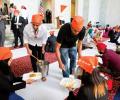
Members of the United States Congress break bread to celebrate the contributions of Sikh Americans. Rediff.com's Aziz Haniffa reports
Milind Deora, minister of state for communication and information technology and shipping, is one of the Congress' young guns under Rahul Gandhi. He tells Kavita Chowdhury that the core problem for the United Progressive Alliance in its second term has been its inability to communicate effectively. Edited excerpts:

'If the money we spend on importing pulses reach our farmers, there won't be any suicides'

'Indian politics has had three-and-a-half master narratives -- secular nationalism, Hindu nationalism, justice for lower castes and regionalism. The AAP seeks to go beyond that. Therein lies its promise and its challenge,' says Ashutosh Varshney, Brown University professor and author of book Battles Half Won, India's Improbable Democracy.
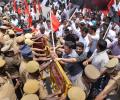
Protester Sasi Perumal's death has given a new fillip to the pro-prohibition movement, which was beginning to draw attention across Tamil Nadu after different political parties began to make it a part of their poll manifesto for next year, says N Sathiya Moorthy.

'Pink a movie that's assembled especially for that section of prejudice-free Indians who are all on this side of the screen.' 'Look...there's virtuosity staring at you, 24 Frames per Second.' 'Soak it in; more power to the revolution, more wax to the candlelight vigils,' says Sreehari Nair.
 © 2026 Rediff.com - Advertise with us - Disclaimer - Privacy Policy - Sitemap - Feedback - About us - Terms of use - Grievances